





How to Select Stone for Your Home Exterior: A Complete Design Guide
DOWNLOAD: How to select stone for exteriors guide
Choosing stone for your home’s exterior is about more than finding a color or texture you like. Exterior stone becomes part of a much larger composition that includes your home’s architecture, siding, roof, windows, doors, landscaping, and surrounding environment.
One of the biggest mistakes you can make is selecting exterior stone solely from an online photo, catalog, or small indoor display. Those resources are excellent for exploring possibilities, but they cannot fully show how natural stone will look across a large exterior surface or under the lighting conditions at your home.
The best way to choose exterior stone is to evaluate its color, undertones, texture, scale, and natural variation alongside your home’s other exterior materials, then view a physical sample at the project site in direct sunlight, shade, and different times of day before making your final selection.
Taking the time to evaluate stone in its future environment can help you make a more confident decision and create an exterior that feels cohesive from the curb to the front door.
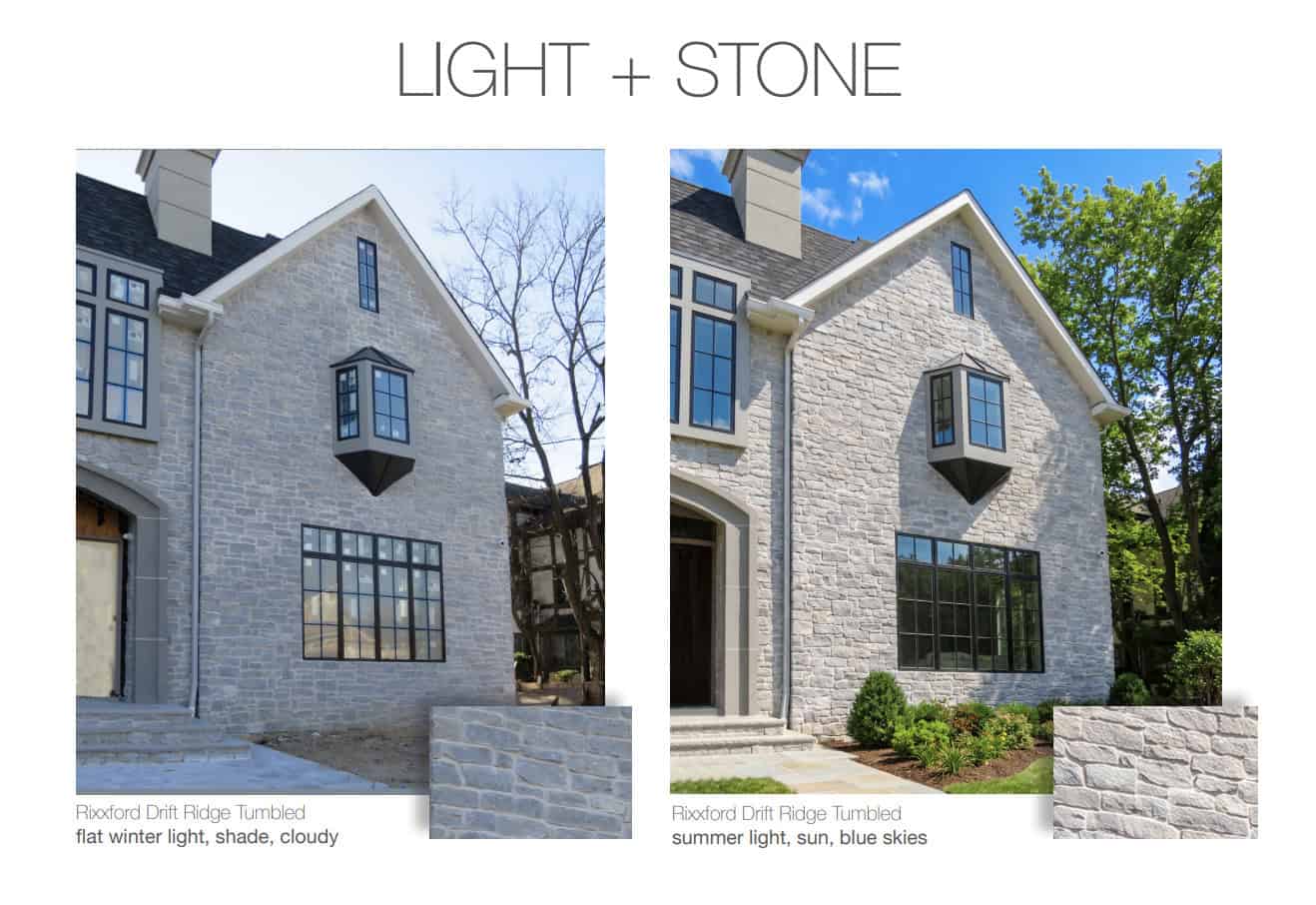
Table of Contents
- How Do You Choose Stone for a Home Exterior?
- Why Does Exterior Stone Look Different After Installation?
- Consider Your Home’s Architectural Style
- Coordinate Stone With Your Other Exterior Materials
- Choose the Right Stone Color and Undertones
- Consider Stone Texture and Profile
- Think About Scale and Viewing Distance
- Understand How Natural Light Changes Exterior Stone
- Compare Exterior Stone in Direct Sun and Shade
- Always Take a Stone Sample Home
- View Your Sample at Different Times of Day
- Consider Natural Stone Variation Before Ordering
- Decide Where the Stone Will Be Used
- Common Exterior Stone Selection Mistakes
- How a Design Consultation Can Help
- Frequently Asked Questions
- Choose Your Exterior Stone With Confidence
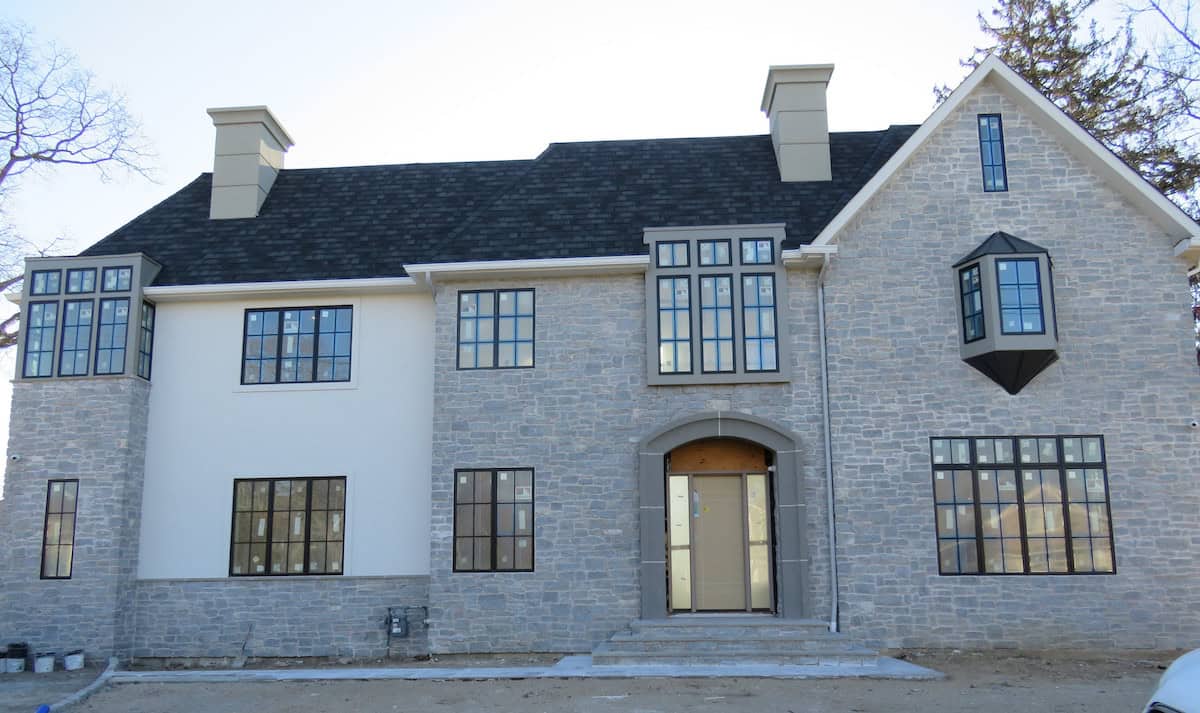
How Do You Choose Stone for a Home Exterior?
Choose exterior stone by considering your home’s architectural style, existing exterior materials, color palette, undertones, stone texture, profile, scale, placement, and natural lighting. Before making a final decision, compare physical stone samples with your siding, roofing, trim, and other finishes at the actual project site.
A good exterior stone should work as part of the entire home rather than simply look attractive on its own.
Start with the home’s architecture and permanent materials. From there, narrow your choices by color and undertone. Next, consider how much texture and variation you want and whether the stone’s proportions make sense for the area where it will be installed.
Finally, evaluate a physical sample outdoors.
That last step is especially important because stone that looks warm and dimensional beneath showroom lighting may appear different outside in full sun, beneath a deep roof overhang, or against your particular siding and roof.
Why Does Exterior Stone Look Different After Installation?
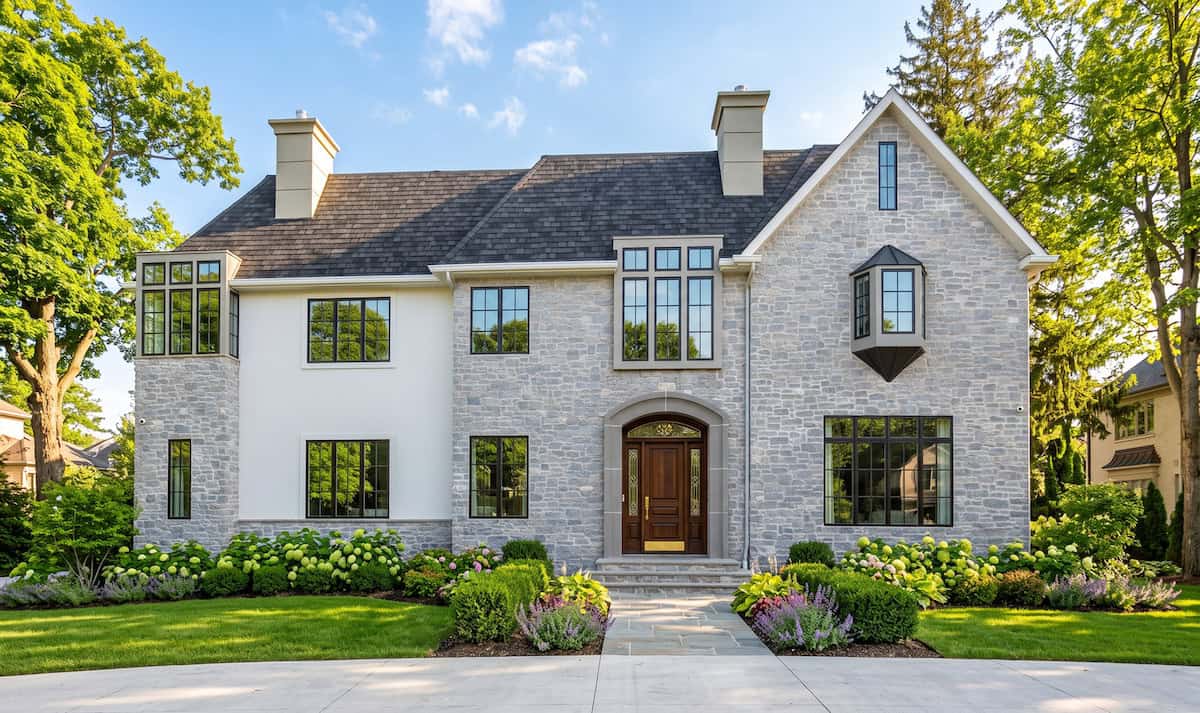
Exterior stone can look different after installation because you’re seeing significantly more material at once and viewing it in an environment with different light, colors, shadows, materials, and viewing distances.
A single sample gives you useful information about the stone, but it doesn’t reproduce an entire façade.
Stone Changes Visually at a Larger Scale
Imagine looking at one stone from a few feet away. You may notice its individual color, texture, veining, and surface characteristics.
Now imagine that material repeated across an entire house.
The overall balance of colors becomes more apparent. Variations between individual pieces contribute to the broader composition, while texture and profile create repeating patterns of highlights and shadows.
This is one reason completed-project photography and larger sample areas can be valuable during the selection process. They provide another perspective on how the stone may read at architectural scale.
Your Surroundings Affect How You See the Stone
Stone doesn’t exist in isolation once it’s installed.
Its appearance is influenced by surrounding siding, stucco, roofing, windows, doors, trim, wood, landscaping, hardscaping, and other materials.
Even nearby colors can affect how you perceive the stone.
For example, a neutral stone placed beside warm wood may emphasize different tones than the same stone beside cool gray siding.
When comparing exterior stone, look at the complete palette rather than evaluating each material separately.
Screens Cannot Perfectly Reproduce Natural Stone
Online photos are valuable for discovering products and gathering design inspiration, but your screen isn’t the same as a physical stone sample.
Photography conditions, exposure, editing, screen brightness, and display settings can all influence the colors you see. Natural stone can also contain variation from one piece to another.
Use online imagery to narrow your choices, then use physical samples to make your final comparison.
1. Consider Your Home’s Architectural Style
Your home’s architecture is one of the best starting points for choosing an exterior stone profile.
You don’t necessarily need to follow strict rules. Instead, think about the visual language already established by the house.
A modern or contemporary home may benefit from streamlined profiles, clean lines, dimensional surfaces, or restrained color palettes.
A traditional home can often support stone with more visible texture, natural movement, and classic proportions.
A Craftsman-style exterior may pair beautifully with textured stone, wood, and other materials that emphasize craftsmanship and natural character.
A farmhouse exterior may call for a lighter or more restrained stone palette that complements siding rather than competing with it.
A rustic home can often accommodate stronger texture, variation, and rugged profiles.
A transitional exterior offers considerable flexibility because it combines traditional and contemporary influences.
Instead of asking, “What stone style is popular?” start with a better question:
What stone profile supports the architecture I already have?
exterior stone inspiration
2. Coordinate Stone With Your Other Exterior Materials
A successful exterior usually feels intentionally connected.
Before selecting your natural stone veneer, gather samples or accurate references for the major materials that will surround it, including:
- Siding
- Stucco
- Brick
- Roofing
- Wood
- Windows
- Exterior doors
- Trim
- Metal accents
- Concrete
- Pavers
Pay particular attention to materials that are expensive or difficult to change. If the roof, windows, and siding have already been selected, your stone should work with those established elements.
You don’t need every material to match.
In fact, too much matching can make an exterior feel flat. Instead, look for coordination through undertones, contrast, texture, and proportion.
A practical approach is to create an exterior material board and view all your samples together outdoors.
3. Choose the Right Stone Color and Undertones
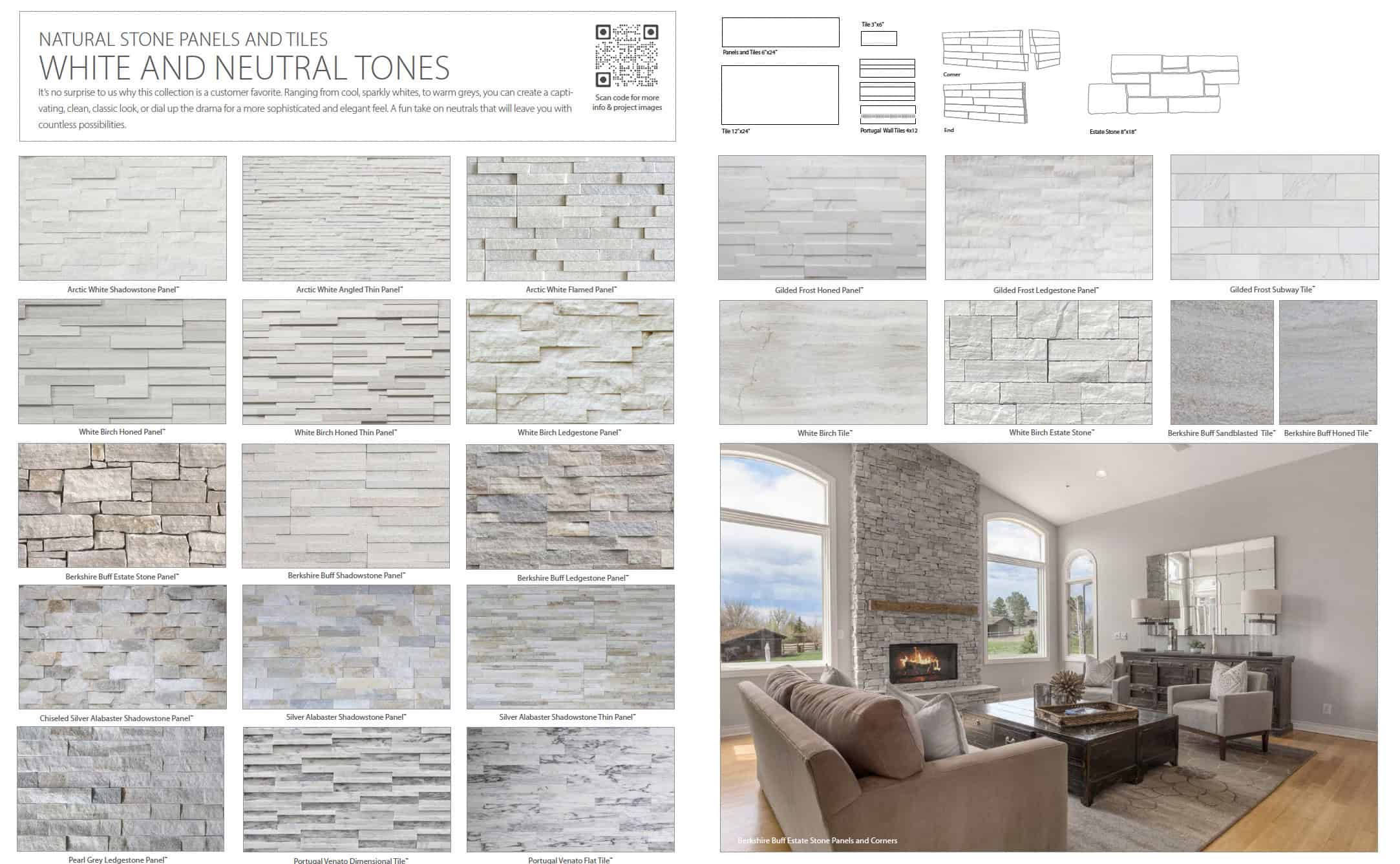
Color is usually one of the first characteristics homeowners notice, but the dominant color is only part of the equation.
Undertones can be just as important as the primary stone color.
Warm Exterior Stone Colors
Warm exterior stone can include shades and variations of:
- Cream
- Beige
- Tan
- Brown
- Gold
- Rust
These colors can complement warm woods, cream-colored siding, earthy roofing, and other warm architectural finishes.
Cool Exterior Stone Colors
Cool stone palettes may include:
- Gray
- Charcoal
- Silver
- Blue-gray
Cooler palettes can create a sophisticated appearance and work particularly well when they relate to other cool or neutral materials on the home.
Neutral Exterior Stone Colors
Neutral options may include:
- White
- Soft gray
- Greige
- Muted natural blends
Remember that “neutral” doesn’t mean a material has no undertone. A soft gray can lean warm or cool, and a greige stone may reveal more beige or gray depending on the surrounding materials and light.
Why Stone Undertones Matter
Suppose your siding and stone are both described as gray.
That sounds like an easy match.
But if the siding has a distinctly blue undertone while the stone has a warm beige or brown cast, the combination may feel less cohesive than expected.
Compare materials side by side in natural light instead of relying only on color names.
4. Consider Stone Texture and Profile
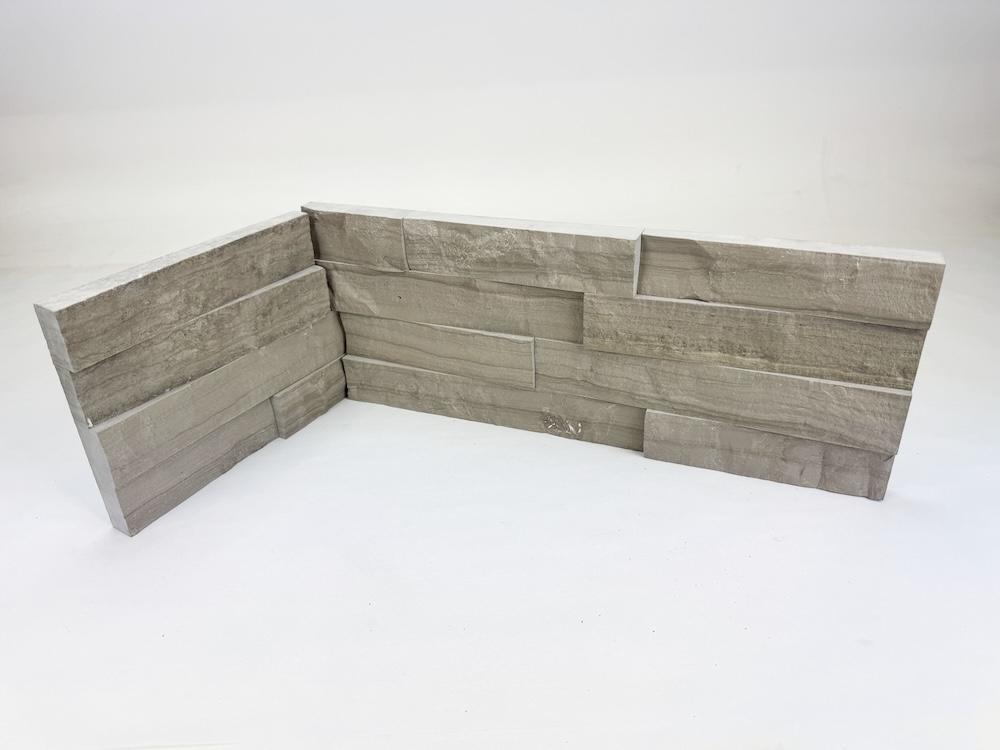
Stone texture and profile influence how much depth, shadow, pattern, and visual movement you see across an exterior. More dimensional surfaces generally create stronger shadows and texture, while streamlined profiles can produce a cleaner, more restrained appearance.
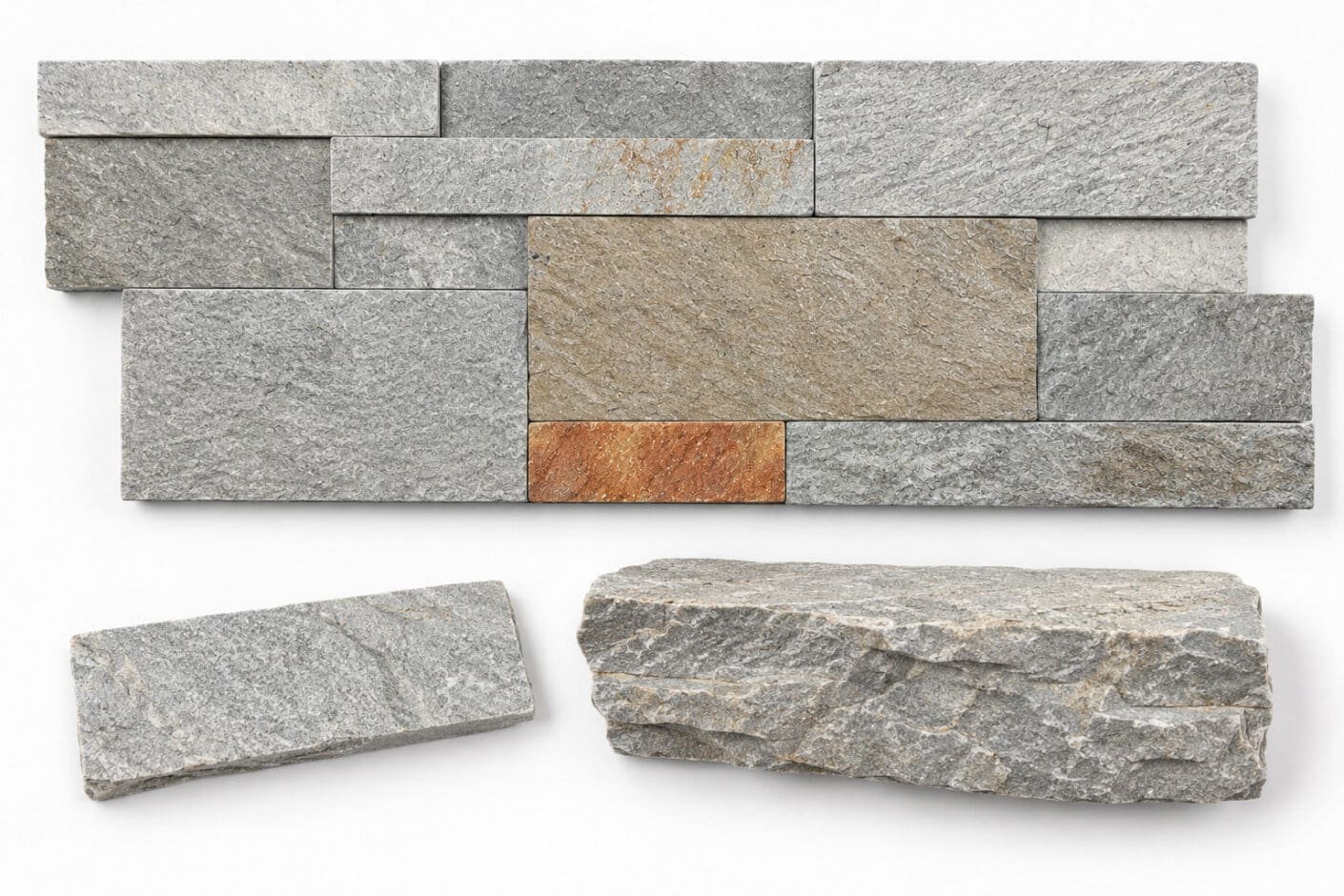
Depending on the design, you might consider exterior stone veneer profiles such as:
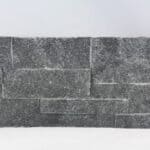
- Ledgestone
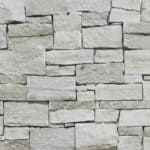
- Stacked stone
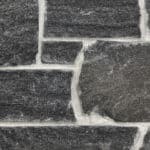
- Dimensional stone
- Split-face stone
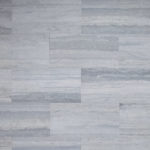
- Smooth or honed stone
- Larger-format profiles
A highly textured stone can become a prominent architectural feature, especially as sunlight creates changing shadows across its surface.
A smoother profile can provide a quieter backdrop and emphasize color, form, and clean architectural lines.
When exploring stone veneer panels, consider both what the individual panel looks like and the overall visual rhythm it will create once repeated across the installation.
5. Think About Scale and Viewing Distance
Stone is often selected from only a few feet away but experienced from much farther away after installation.
That difference matters.
A texture that appears highly detailed while you’re holding a sample may read as a unified surface from the street. Conversely, dramatic color variation or large profiles may become much more noticeable across an expansive façade.
Large Exterior Walls
For large walls and full façades, consider the stone’s overall pattern, scale, color distribution, and visual movement.
Ask yourself how the material will look from across the driveway or street—not only from arm’s length.
Entryways and Smaller Accent Areas
Smaller areas can provide opportunities to introduce contrast and texture without allowing the stone to dominate the entire exterior.
Entryways are especially important because they’re experienced both from a distance and close up.
Columns and Architectural Details
Columns, corners, transitions, window areas, and termination points deserve special attention.
Consider how the stone will wrap corners and meet adjacent materials. These details can significantly influence whether the finished installation feels intentional.
6. Understand How Natural Light Changes Exterior Stone
Natural light can change how exterior stone appears by emphasizing or muting its colors, texture, shadows, and mineral variation. Direct sunlight may make certain tones and surface details more noticeable, while shaded conditions can make the same stone appear cooler, deeper, softer, or more subdued.
This is one of the most important reasons to view exterior stone at your actual project site.
Exterior lighting isn’t static.
The angle and intensity of sunlight change throughout the day. Different sides of a home may receive very different amounts of light, and rooflines, porches, landscaping, trees, and nearby structures can create permanent or shifting shade.
A stone you love in bright midday sun should also work when that wall falls into shade.
7. Compare Exterior Stone in Direct Sun and Shade
Don’t simply take your stone sample outside for five minutes. Move it through the different lighting conditions it will actually experience.
Direct Sunlight
Direct sunlight can make colors and surface characteristics easier to see while producing stronger highlights and shadows on dimensional stone.
Look at both the dominant color and smaller variations within the stone.
Partial Shade
Partial shade is particularly important if your façade sits beneath trees, roof overhangs, porches, or other architectural elements.
Observe whether the overall color still works with the surrounding materials when direct sunlight is reduced.
Deep Shade
Why does stone look darker in the shade?
Stone can appear darker in shade because less direct light reaches the surface. With fewer bright highlights, some colors may appear deeper, cooler, or more subdued.
The stone itself hasn’t necessarily changed—the lighting conditions have changed how your eye perceives it.
Trees, Rooflines, and Nearby Structures
Think beyond today’s conditions.
Trees can cast moving shadows. Deep eaves may prevent direct sunlight from reaching part of a façade. Nearby buildings and landscape elements can influence the amount and character of light reaching the stone.
The most useful test is the environment where the stone will actually be installed.
8. Always Take a Stone Sample Home
Yes, you should take an exterior stone sample home before making your final selection whenever possible.
A physical sample allows you to compare the stone directly with your home’s:
- Siding
- Roof
- Windows
- Trim
- Doors
- Wood finishes
- Hardscaping
- Landscaping
- Natural lighting
Place your [stone sample] as close as practical to the proposed installation area.
If you’re comparing several options, view them together first and then separately. One color can influence how another appears when they’re positioned side by side.
Physical samples are especially important with natural materials because color, veining, inclusions, surface characteristics, and other natural variations can differ from piece to piece.
9. View the Sample at Different Times of Day
A stone sample shouldn’t pass just one lighting test.
Leave yourself enough time to see it under several conditions.
Morning Light
Look at the stone during the morning, particularly if the proposed wall receives early sunlight.
Notice the dominant color, undertones, shadows, and texture.
Midday Sun
Midday provides another useful comparison point because the sun is positioned differently and may illuminate the façade more directly.
Step close to inspect the material and then farther away to judge the overall impression.
Afternoon and Evening Light
Late-day conditions may create a different visual effect, particularly on walls receiving afternoon sun.
Again, pay attention to both color and texture.
Exterior Lighting at Night
Will landscape or architectural lighting illuminate the stone after dark?
If so, evaluate the sample under similar artificial lighting when possible. Directional exterior lighting can emphasize the relief and shadow of dimensional stone.
Helpful tip: Photograph your sample from approximately the same location in the morning, midday, afternoon, and evening. Reviewing the images together can make differences easier to spot.
10. Consider Natural Stone Variation Before Ordering
One of the qualities that gives natural stone its distinctive character is variation.
Colors, veining, inclusions, texture, and other characteristics can vary between individual pieces. That means one small sample should not be interpreted as an exact representation of every stone that will appear across the finished project.
For a larger exterior installation, consider viewing multiple pieces, a larger sample area, or completed project photography whenever possible.
The goal isn’t to eliminate natural variation. It is to understand and plan for it.
A thoughtful installation can distribute variation across the surface so the finished façade feels balanced and natural.
11. Decide Where the Stone Will Be Used
The best exterior stone choice can also depend on where you plan to use it.
Common applications include:
- Full façades
- Exterior wainscoting
- Entryways
- Columns
- Chimneys
- Accent walls
- Outdoor kitchens
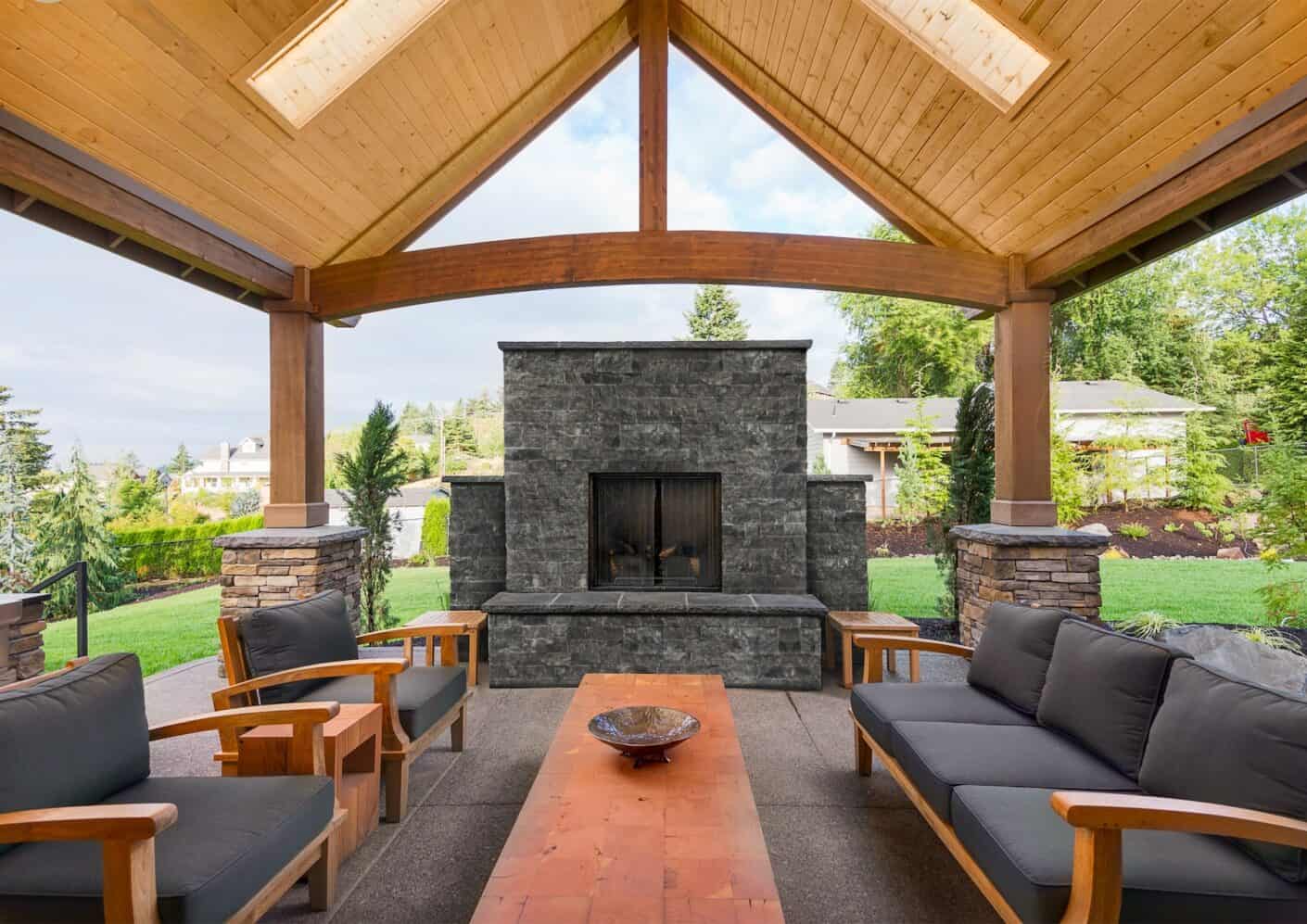
- Exterior fireplaces
- Retaining and landscape features
A full façade creates a very different visual effect than a smaller stone accent.
If you’re covering a large percentage of the house, the stone becomes a major component of the exterior color palette. If you’re using stone selectively, it can act as a visual anchor that connects other materials.
Browse an [exterior inspiration gallery] to compare full façades, mixed-material homes, fireplaces, and other applications at realistic architectural scale.
For patios, kitchens, fireplaces, and entertaining areas, exploring [outdoor living stone] applications can also help you see how stone relates to surrounding hardscape and landscape materials.
What Are the Most Common Exterior Stone Selection Mistakes?
The most common exterior stone selection mistakes are choosing from online images alone, ignoring natural light and undertones, evaluating too little material, and failing to consider how the stone will interact with the home’s other exterior elements.
Here are 10 mistakes to avoid:
- Choosing from online photos alone. Use digital imagery for inspiration and comparison, then evaluate physical samples before making the final decision.
- Evaluating only one small sample. A single piece cannot show the full range of variation you may see across a larger installation.
- Ignoring natural lighting. A sample viewed only indoors doesn’t tell you how the stone will behave in direct sun or shade.
- Looking at stone separately from siding and roofing. Exterior materials should be evaluated as a coordinated palette.
- Ignoring undertones. Similar dominant colors can still clash when their underlying warm and cool tones don’t relate well.
- Choosing a profile that’s out of scale with the house. Consider the size of the façade and how far away the stone will normally be viewed.
- Expecting natural stone to be perfectly uniform. Natural variation contributes to the character of the material.
- Viewing samples only indoors. Showroom lighting and exterior daylight can create very different impressions.
- Forgetting corners and transitions. Think about how stone meets siding, windows, doors, columns, trim, and other architectural features.
- Making the final decision too quickly. Give yourself time to view the stone in multiple lighting conditions before committing.
How Can a Design Consultation Help You Choose Exterior Stone?
Exterior material decisions involve many variables, and a design professional can help you see relationships that are difficult to evaluate one sample at a time.
A consultation can help you assess:
- Your home’s architectural style
- Overall exterior color palette
- Stone colors and undertones
- Profile and texture
- Scale and proportions
- Intended application
- Existing exterior materials
- Sample comparisons
- Overall design direction
Realstone’s design staff can help homeowners and design professionals compare stone products and consider how different options may work within a specific project.
You can also use the [Realstone Visualizer Tool] to explore products in a visual context before narrowing your selections and evaluating physical samples.
For additional one-on-one guidance, schedule a [design consultation] to discuss your project and stone options.
Frequently Asked Questions About Choosing Exterior Stone
What Color Stone Should I Choose for My House?
Choose an exterior stone color that complements the undertones and overall palette of your siding, roof, trim, windows, doors, and other permanent materials.
Don’t focus only on whether the stone is gray, beige, white, or brown. Compare its undertones with the materials around it and check the combination outside in natural light.
Should Exterior Stone Match the Roof?
Exterior stone does not need to match the roof exactly.
A coordinated exterior often works better when the materials share complementary undertones or create intentional contrast rather than being identical in color.
Because a roof is such a large visual element, always include it when evaluating your overall exterior palette.
Should Exterior Stone Match the Siding?
Stone and siding don’t need to be the same color, but they should feel intentionally coordinated.
You might use similar undertones for a subtle, unified palette or introduce controlled contrast to make the stone more prominent.
View samples together before deciding.
Does Natural Stone Look Different in Sunlight?
Yes. Natural stone can appear different in sunlight because changing illumination affects how you perceive its color, texture, shadows, and natural variation.
Direct sun may reveal details and produce stronger highlights, while shade may create a deeper or more subdued appearance.
Why Does Stone Look Darker When It Is Shaded?
Stone often looks darker in shade because less direct light reaches its surface, reducing bright highlights and changing the way its colors and texture are perceived.
This is why an exterior sample should be viewed in both direct sunlight and shade.
How Large of a Stone Sample Should I Look At?
A larger sample area generally provides more useful information than one isolated piece because it lets you see more of the material’s color, pattern, texture, and natural variation.
If only a small sample is initially available, combine it with additional samples, larger displays, completed-project images, or mock-ups where practical.
Should I Take an Exterior Stone Sample Home Before Buying?
Yes. Taking an exterior stone sample home is one of the most useful steps you can take before making a final selection.
Place it near the intended installation area and compare it with your siding, roof, trim, windows, doors, and hardscaping in both sun and shade.
How Do I Know What Stone Will Look Like on My Whole House?
No single tool can reproduce every aspect of a finished natural stone exterior.
For the most complete picture, combine:
- Physical samples
- Larger sample areas or mock-ups when available
- Completed-project photography
- A visualization tool
- Professional design guidance
Most importantly, evaluate the physical material at the project site.
Can I Mix Stone With Siding on My Exterior?
Yes. Stone and siding can work very well together when their colors, undertones, proportions, textures, and transitions are intentionally coordinated.
Consider which material will be dominant and where transitions between stone and siding will occur.
What Exterior Stone Style Works With a Modern Home?
Modern homes can work particularly well with streamlined profiles, dimensional stone, larger-format materials, clean horizontal or geometric lines, and restrained color palettes.
However, there’s no single “modern stone.” The best choice depends on the home’s architecture, surrounding materials, scale, and desired degree of contrast.
Is Natural Stone a Good Choice for Exterior Applications?
Natural stone can be an excellent exterior material when the specific product is suitable for the intended application and is installed correctly.
Before selecting any product, consider the climate, substrate and wall assembly, moisture management, installation method, local building requirements, and product-specific installation specifications.
Not every stone product is appropriate for every exterior condition, so confirm exterior suitability before ordering.
Choose Your Exterior Stone With Confidence
Choosing exterior stone isn’t about finding the perfect sample under perfect showroom lighting.
It’s about finding the right stone for your home.
Consider your architecture. Compare your exterior materials. Look closely at color and undertones. Think about texture, profile, scale, and viewing distance. Understand natural variation.
And, most importantly, see the stone where it will actually live.
Don’t choose exterior stone based solely on how it looks on a screen or inside a showroom. Take a physical sample to your project site and view it in direct sun, shade, and different times of day before making your final decision.
Realstone’s design staff can help you compare stone colors, profiles, textures, and applications to find an option that complements your home’s exterior.
Ready to take the next step? Order stone samples and view them at your project site, explore the Realstone Visualizer Tool, or schedule a design consultation with Realstone for personalized guidance.